
The banker is the hero. The platform does the rest.
Upload the deal materials and the platform conducts every investor conversation in parallel — a cited answer in under ten seconds, in the investor’s language, around the clock — while the book fills in front of you. One banker covers hundreds of investors instead of fifty. You keep negotiation, allocation and closing.
Instant Bloomberg records the order. BookRunner runs the conversation that gets you there.
Not a CRM to log what happened. Not a data room to browse. The engine that runs the deal in flight.
The Live Board: build your book in hours, not days.
Every investor on the issuance, in five columns: Early, Reached out, Asking, Interested, Indications. Book fill against target. And a “needs your attention” list that says why — an investor asked something outside the documents, a forbidden topic came up, someone signalled interest and is waiting for a person.
The issuance, start to finish
Set the family — equity, debt, private fund — load the documents, write the disclaimer, choose the investors. A readiness rail tells you what is still missing. Nothing goes out.
The issuance goes online to the investors you chose. Outreach goes by messaging app or Direct, in the investor’s language, with the teaser attached. Conversations start.
Terms firm up. The offering takes the form the deal takes — SEC-registered, 144A to qualified institutional buyers, Reg S offshore, an Israeli institutional tender ahead of a public tranche, or a fund’s own subscription.
The book is frozen. The Compliance Conversation Report is generated. Nothing is edited afterwards — by anyone.
While an issuance is online, nothing about it is editable. To change a document or a term, you pause it, change it, and bring it back. Investors never see a half-changed deal.
Documents
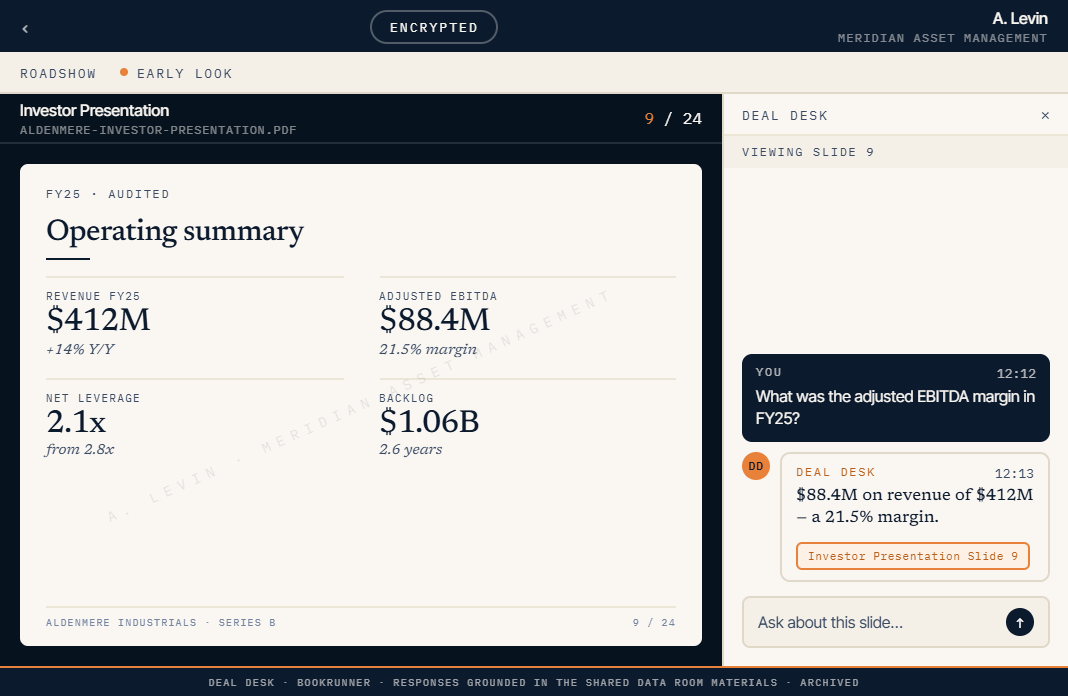
Prospectus, teaser, deck, trust deed, ratings. Each is indexed on upload; each answer cites the page or slide it came from. A document marked Draft is answered as a draft. A deck opens in an interactive viewer on the investor’s phone, with the slide beside the answer.
A banker adds their own documents to an issuance at any point — a memo, a model summary, an answer note the desk wants used. And where the issuer is a public entity, the filings come in without anyone fetching them: from the platform’s own library for deals already on it, and from the regulator directly — EDGAR in the United States, the ISA’s Magna in Israel. A filing arrives with its date and source attached, so an answer drawn from it cites the filing rather than a copy of it.
After the deal
One document per issuance: every question and answer with its document grounding, every escalation and its reason, every indication with its time, identities masked where they should be. Branded to your firm. Generated at close.
The desk’s own record of how each investor works: the kinds of questions they ask first, the terms they care about, the language and channel they prefer, the documents they always want. Nothing about their portfolio or their positions — only what they told you, so the next conversation starts where the last one finished instead of at the beginning.
Upload a meeting export; the questions asked are attributed to the investor who asked them and land on their profile.
Tools you’ll use every week
A branded, bilingual teaser from any priced deal, PDF and web, in one click.
One message to every investor on the deal when terms change, in each investor’s language.
Add an investor, send the first message, or hand them a QR code at a meeting.
Deal families
Equity. Debt. Private funds — where the raise has two conversations, screening across the whole base and then one-on-one with the sponsor, and where the channel stays open after close.