
Know the book before you build it.
BookRunner reads the market the way a desk wishes it could: every institution’s holdings across four asset classes, every filing, every fee, every public call — computed once, reconciled to the filing, and put where the desk works.
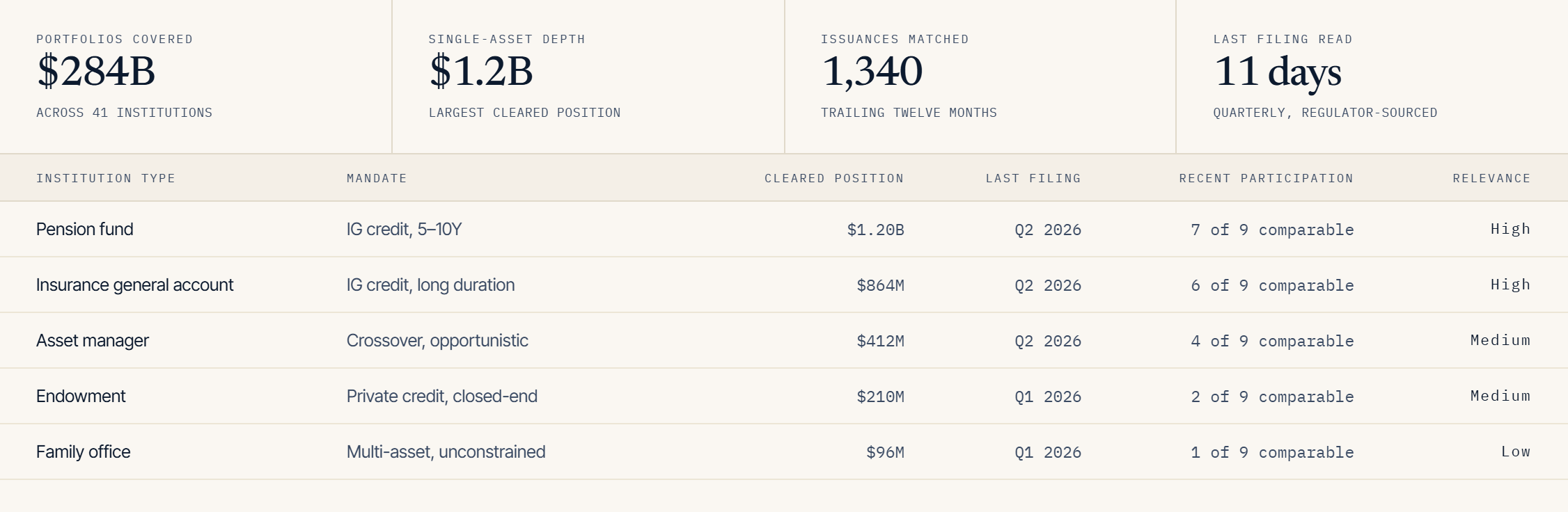
The point is not to reach every investor. It is to reach the right ones.
An investor who is sent every issuance stops reading them. Targeting is not a marketing nicety on a desk — it is how the relationship survives the fifth deal of the quarter. So the intelligence is built in before the outreach is: the desk knows who a deal is for, and who to leave alone, before the first message goes out.
Coverage of the large institutions comes from what they already publish — regulatory filings and quarterly reports — read as a book rather than as documents. That is enough to see the shape of a mandate: what they hold, what they are allowed to hold, and what they have been buying.
Filings and quarterly reports give the mandate as it actually is — asset classes, rating floors, duration, sector and theme exposure. Not what an investor said in a meeting two years ago.
Quarter on quarter, position by position, with the change decomposed into the manager’s decision, the price, and the currency. A holding that grew because the market rose is not a conviction.
Who participated in which issuance, at what size, in what structure. Relevance becomes evidence from the record rather than a judgment made from a contact list.
Three levels
Holdings across corporate bonds, equities, private credit and private funds. What moved last quarter and how much of it was the manager, the price, or the currency. What is being priced in Israel and the US, at what fee. Who is on the public calls. This belongs to BookRunner; every desk on the platform reads it.
Your book, your investors’ questions, what each one asked, preferred and moved on, issuance after issuance. This belongs to you and never leaves your tenant.
Continuity across every Arranger’s deals on Direct, and access to it through the investor’s own agent. This belongs to the investor.
What the platform level holds
Institutional holdings by issuer and series, quarter on quarter.
Holdings by issuer, with the same decomposition.
The private-credit book, by manager and fund.
Commitments by sponsor and fund.
Two pipelines.
Every filing, underwriter fees, what was actually raised.
Every debt and equity print, classified and extracted, with a bookrunner league.
Public calls.
The public-call feed for the Israeli market. A BookRunner participant attends announced investor calls and webcasts so that the call becomes part of the issuer’s record rather than one analyst’s notes; it is a visible named participant, does not speak, and records no audio, video or transcript.
How the participant worksHow the numbers are made
Every figure is computed once, at ingest, and stored. Nothing is recalculated on a page.
- Computed once, at ingest — never recalculated on a page.
- Every figure carries its source and reconciles to the filing it came from.
- When a figure can’t be sourced, it isn’t shown.
Where it appears
Some of it is built into the platform — it appears where the desk works: which investors to call, what the report says, what the Board flags. The deeper layers are available separately.